Google had spent the previous year insisting Android was a platform for thousands of phone models, not a single Google Phone.
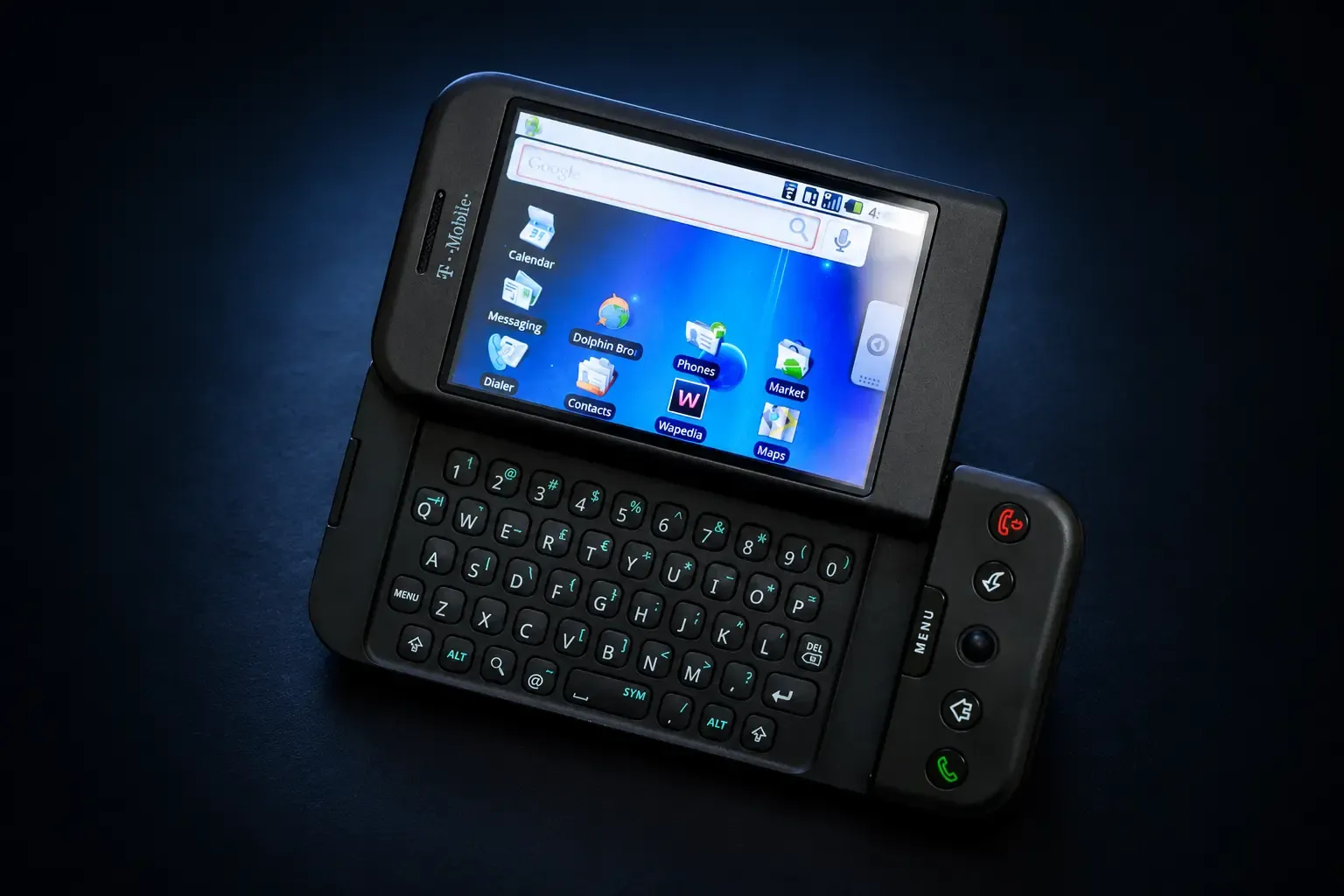
On September 23, 2008, T-Mobile, HTC, Google and Deutsche Telekom stood on a stage in New York and unveiled the first one anyway: the T-Mobile G1.
Outside the US and UK it was sold as the HTC Dream. It had a 3.2-inch touchscreen, a slide-out QWERTY keyboard and a trackball. The screen was capacitive, but Android didn’t yet support multitouch — so there was no pinch-to-zoom, just on-screen buttons.
It ran Android 1.0.
It was cheaper than the cheapest iPhone 3G. Android Market — the app store that would later become Google Play — launched alongside it, still in beta.
Andy Rubin, the Google executive who had led Android’s development, spoke at the launch.
Near the end, Google co-founders Sergey Brin and Larry Page made a surprise appearance.
Brin described an app he had built himself: it used the phone’s accelerometer to time how long the device took to hit the ground after being thrown in the air.
Page said he had vetoed shipping it: “I suggested we not ship that app.”
It went on sale in the US a month later, on October 22 — only in the cities where T-Mobile had already switched on 3G.
For the first time, Android was not a promise. It was a phone with a price tag that anyone could buy, and a platform anyone could actually write software for.
Google’s original announcement · TechCrunch’s live-blog from the event
See also Sergey Brin, Google Co-Founder and Computer Scientist and Oracle Sues Google Over Java in Android.