Journal •
All Articles
Browse the complete archive of articles on the history of information technology.
-
 September 6, 2000
RSA becomes free
On September 6, 2000, RSA Security stopped enforcing its RSA patent against third-party implementations, two weeks before the patent was due to expire.
-
 August 21
Sergey Brin, Google Co-Founder and Computer Scientist
On 21 August 1973, Sergey Brin was born in Moscow — a programmer, researcher, and one of the two founders of Google.
-
 August 15, 1998
The Apple iMac Goes on Sale
The first Apple iMac reached buyers: a translucent Bondi Blue all-in-one that dropped the floppy drive and bet everything on USB.
-
 August 14, 2013
Telegram Launches on App Store on This Day in 2013
On this day in 2013, Pavel and Nikolai Durov launched Telegram, emphasizing privacy, security, and independence as it began its global growth.
-
 August 13, 1973
ICCP: The First Independent Certification for Programmers
Learn how ICCP became the first independent organization to certify programmers, setting industry standards in the mid-20th century.
-
 August 12, 2010
Oracle Sues Google Over Java API Use in Android
Oracle sued Google over Java API copyright and patent claims in Android; the case lasted 11 years and concluded with a Supreme Court ruling on fair use.
-
 August 11, 1994
The First Encrypted Credit Card Payment on the Internet in 1994
Discover how the first encrypted online credit card payment was made in 1994, marking a key moment in e-commerce security.
-
 August 10, 2007
A Key Court Ruling in the SCO–Linux Disputes
On August 10, 2007, a U.S. federal court ruled that the copyrights to UNIX belonged to Novell rather than The SCO Group — the turning point in the SCO–Linux disputes.
-
 August 9, 1925
David Huffman and the Creation of Huffman Coding in 1952
Learn how David Huffman invented the efficient Huffman coding algorithm in 1952, impacting data compression, digital circuits, and computer vision.
-
 July 20, 1942
James David Foley: Contributions to Computer Graphics and HCI
Learn about James David Foley’s role in advancing computer graphics, human-computer interaction, and his influence through education and research.
-
 July 19, 1977
The First GPS Signal Was Received
On July 19, 1977, engineers at Rockwell Collins received and decoded the first GPS signal from the experimental NTS-2 satellite, a key milestone in the development of the NAVSTAR GPS program.
-
 July 18, 1968
The Founding of Intel by Noyce and Moore
Learn how Robert Noyce and Gordon Moore founded Intel on July 18, 1968, transforming the semiconductor industry with their innovative company.
-
 July 17, 1899
NEC Was Founded in Tokyo
On July 17, 1899, Nippon Electric Company (NEC) was founded in Tokyo, becoming Japan's first international technology company and a pioneer in Japanese computing and supercomputing.
-
 July 16, 1995
Amazon.com Launched as an Online Bookstore
Amazon.com launched on July 16, 1995, as an online bookstore with about one million titles, marking its start before expanding into a tech giant.
-
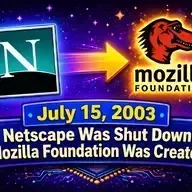 July 15, 2003
Netscape's Closure and the Creation of Mozilla Foundation
On July 15, 2003, AOL closed Netscape's team and established the Mozilla Foundation, shaping the future of open web standards and browser development.
-
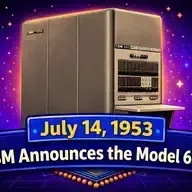 July 14, 1953
IBM Announces the Model 650
Learn how IBM's Model 650, announced on July 14, 1953, became the first mass-produced computer and a major milestone in making computing accessible.
-
 July 13, 1987
How Metal Gear Changed Action Game Design in 1987
Released on July 13, 1987, Metal Gear revolutionized action games by introducing stealth gameplay and complex storytelling, shaping future game design.
-
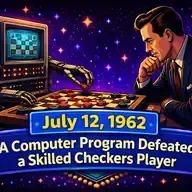 July 12, 1962
IBM Checkers Program Defeats Human Player
On July 12, 1962, IBM engineer Arthur Samuel's checkers program defeated a strong human player, marking a milestone in AI and machine learning.
-
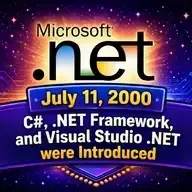 July 11, 2000
Microsoft Introduces .NET, C#, and Visual Studio .NET at PDC
On July 11, 2000, Microsoft announced the .NET platform, C#, Visual Studio .NET, and the CLR at PDC, shaping future software development.
-
 July 10, 2008
How the 2008 Launch of the App Store Changed Mobile Software
Learn how the 2008 launch of Apple's App Store introduced a new mobile app economy, offering a unified platform for discovery, purchase, and security.