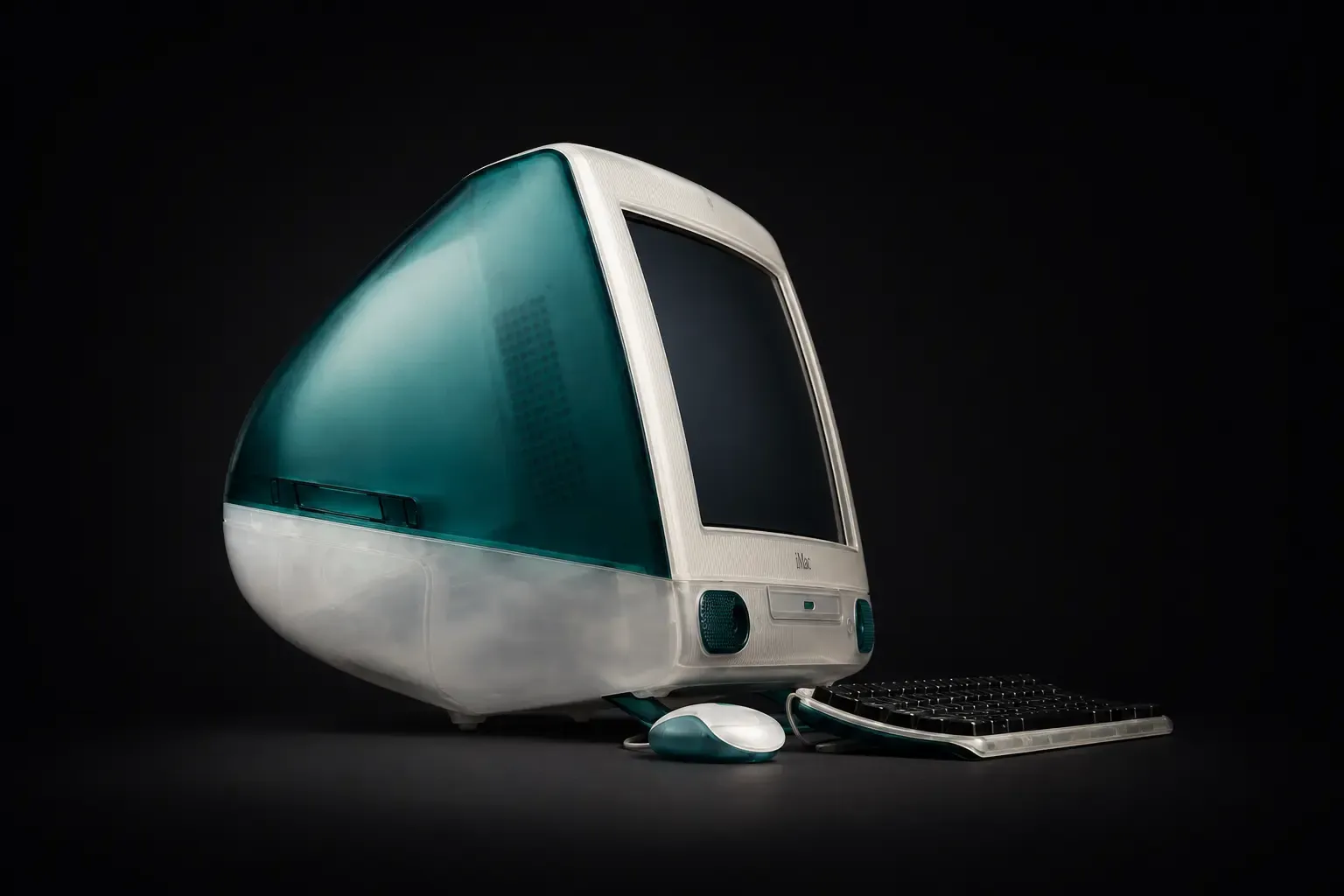
The first Apple iMac went on sale — a translucent blue-green computer that looked nothing like almost any other PC of its time. Apple had unveiled it a few months earlier, on May 6, and on August 15 the first iMacs became available to buyers.
The iMac arrived at a very difficult moment for Apple. Steve Jobs had returned to the company in 1997 and started aggressively cutting and simplifying the product line. The iMac was Apple’s first new product under the returning Jobs, and one of the most important steps in the company’s recovery from its mid-1990s crisis.
The machine’s look came out of the industrial design team led by Jony Ive. Instead of the usual beige box, the result was an all-in-one with a 15-inch CRT monitor and a translucent Bondi Blue case. The collaboration between Jobs and Ive around the iMac later became one of the foundations of Apple’s new approach to product design.
Inside was a PowerPC G3 running at 233 MHz, 32 MB of RAM and a 4 GB hard drive. The computer had Ethernet, a modem and a CD-ROM, and sold for $1,299. The name iMac was tied above all to the Internet: at the presentation, Jobs explained that the computer was built so that an ordinary user could get online quickly and easily.
But one of the most interesting things about the iMac was what it did not have.
Apple dropped the 3.5-inch floppy drive, along with the ADB, SCSI and serial ports that Macintosh users took for granted. In their place, the iMac got two USB ports. For Mac owners this was a fairly painful decision: older peripherals simply would not connect to the new computer without extra adapters.
The decision turned out to matter for the whole industry. The iMac was the first Mac with USB, and one of the most visible mass-market computers to make the new interface attractive to makers of keyboards, mice, printers and other peripherals. At the same time, Apple was effectively declaring that it considered the floppy disk an obsolete technology.
And the risk paid off. In the first six weeks Apple shipped 278,000 iMacs — at the time, that made it the fastest-selling Macintosh in the company’s history. More than 40% of buyers had never used a Mac before: 29.4% were buying their first computer, and another 12.5% were switching from Windows PCs.
Saying that the iMac alone “saved Apple” would be too much of a simplification. The company’s comeback took several years and involved many decisions by Jobs and his team. But the iMac was certainly one of the main symbols of that comeback. It sold well, brought new customers to Apple, and pointed to the direction the company would keep moving in: less compatibility with the past, a simpler product line, and far more attention to how a device looks and feels in everyday use.
Sources
- Apple Support — iMac (Bondi Blue) technical specifications
- Apple — press release on the iMac’s success (October 1998)
- Computer History Museum — Timeline of Computer History, 1998
- Computer History Museum — Steve Jobs: The Authorized Biography, an evening with Walter Isaacson
- Macworld — review of the original iMac
- Macworld — iMac at 20: 10 iMac facts and history in pictures
- Macworld — the iMac three years on
See also The Launch of the iMac: A Turning Point in Tech History (May 6, 1998) and Feb 24, 1955 — Steve Jobs Is Born.